

Product Description
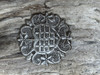
This is the medallion reading of Erzulie Freda's veve. Rather than cut the background away, this artist has worked the whole symbol in relief on a solid round disc with a scalloped edge, brightened the steel to silver, filled the heart with a fine lattice and set four flower rosettes at the compass points. Every surface carries hand-punched dot texture. It is the denser, busier, more worked of the two. We carry a second version of this same veve, cut by a different artist as open line in dark oxidized steel. Same spirit, same symbol, two hands. They are made to be seen together and many customers take the pair. Reading This Veve A veve is the emblem that belongs to one lwa alone - one of the spirits served in Haitian Vodou - traced in cornmeal and wood ash on the floor of the temple to call that spirit by name. Look for the heart at the center, whole and unbroken, which is Erzulie Freda's. The vertical line running through it is the axis of the drawing, and in the temple the spirits are called down along the poto mitan, the center post the drawing is traced around. An unbroken heart is what distinguishes Freda from her sister Erzulie Dantor, whose heart is run through with a blade. Two lwa of love, two different kinds of love, one detail between them. Who Erzulie Freda Is Erzulie Freda - Ezili Freda in Kreyol - is the lwa of love, beauty, luxury and femininity, and a great power as a lover. She is also known for her jealousy and her unpredictable nature; she is not a gentle spirit, she is a passionate one. She wears three wedding rings, one for each of her husbands, and she is offered perfume, jewelry, flowers and sweet liqueurs. Her colors are pink, blue, white and gold. In Haiti she is syncretized with Mater Dolorosa, Our Lady of Sorrows. About This Piece This ornament begins as a 50-gallon steel oil drum. The artist burns out the inside with banana and sugar cane leaves, cuts the drum open and flattens it into a metal canvas roughly 3 feet by 6 feet. The design is then traced and worked entirely by hand with a hammer and chisel, and finished with a protectivecoating. The work is done in Croix des Bouquets, Haiti, where this tradition has been passed down since the 1950s. No two pieces are identical. Fair trade. The artist is paid directly. 4 inches. Hangs as an ornament or sits as a small wall piece. It's Cactus Metal Art Haiti